> For the complete documentation index, see [llms.txt](https://docs.auto.finance/llms.txt). Markdown versions of documentation pages are available by appending `.md` to page URLs; this page is available as [Markdown](https://docs.auto.finance/auto-pools-protocol/custom-autopools.md).
# Custom Autopools
## Ecosystem Specific Autopools
Autopools are in essence customizable networks of automated liquidity, tokenized and made composable by their respective receipt token. This allows for a new way to combine utility with distribution. \
\
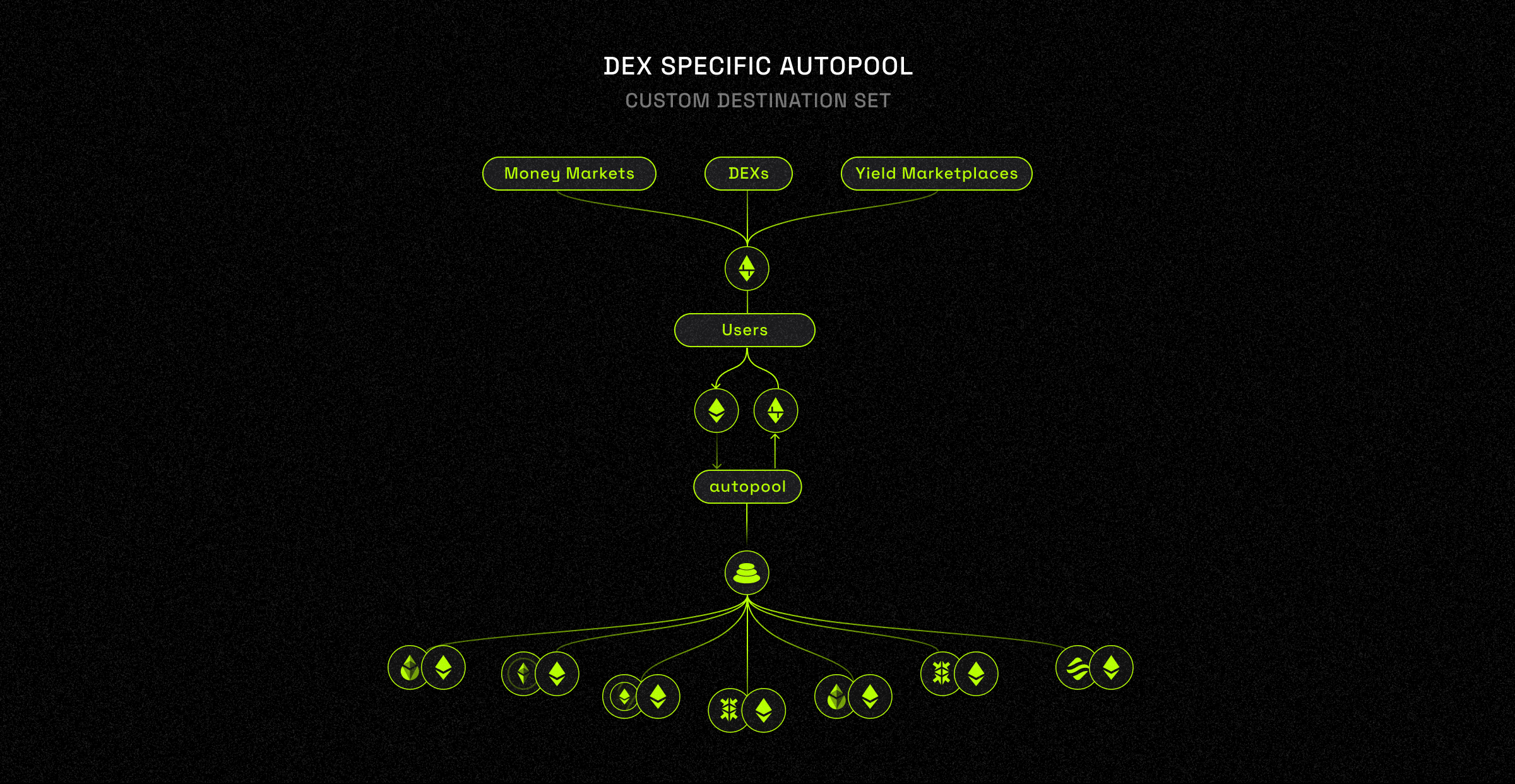
For instance, an autopool tailored for the XYZ DEX, featuring a custom selection of pools (e.g., correlated ETH pairs), which then distributes branded receipt tokens (e.g., xyzETH) to LPs.\
Once set up, the user experience is simple: provide ETH, receive xyzETH, and the underlying liquidity remains optimally deployed, while remaining within the DEX ecosystem. \
This approach creates passive yield opportunities for users, which retain all underlying liquidity within a single ecosystem, thus promoting sticky liquidity and broadening the addressable market.
Example of a DEX specific Autopool
## The Future of Autopools
A natural next step is to enable the permissionless creation of autopools. This feature will allow users to express individual risk preferences and allows different participants, such as risk managers, to contribute specialized skills. \
\
The architecture of autopools also allows to develop solutions for other problem sets requiring optimization, such as e.g. point systems.
---
# Agent Instructions
This documentation is published with GitBook. GitBook is the documentation platform designed so that both humans and AI agents can read, navigate, and reason over technical content effectively. Learn more at gitbook.com.
## Querying This Documentation
If you need additional information that is not directly available in this page, you can query the documentation by asking a question.
Perform an HTTP GET request on the following URL with the `ask` and `goal` query parameters:
```
GET https://docs.auto.finance/auto-pools-protocol/custom-autopools.md?ask=&goal=
```
`ask` is the immediate question: it should be specific, self-contained, and written in natural language.
`goal` is what the user is ultimately trying to achieve, the reason they need the answer. Sharing it helps GitBook give you a better, more relevant answer. A goal is most helpful when it describes the outcome the user wants rather than restating the question. For example, with `ask=how do I create an API token`, a goal like `automate deployments from our CI pipeline` lets GitBook tailor the answer to that use case.
The response will contain a direct answer to the question and relevant excerpts and sources from the documentation.
Use this mechanism when the answer is not explicitly present in the current page, you need clarification or additional context, or you want to retrieve related documentation sections.